We did, but we also knew it was a long ways to the state park where we planned to spend the night, and Carol was a little concerned about her engine overheating. The dilemma was solved when we were told we could park anywhere on the grounds for the night. Our "tour" cost $5 and came with a golf cart, a set of keys to get in the buildings, and self-guided tour information.
Carol and I spent a delightful 2+ hours exploring this restored turn-of-the-century community.
We learned that the name Green Frog came from a circa 1920 local country store and surrounding community by the same name.

The 1915 Eatman Cotton Gin is being restored to working condition. I have read about the cotton gin, but have never seen one and it was fascinating to learn how it worked.


These huge pulleys fill up the bottom floor area.

Cotton hanging from the rafter.

A basket of cotton

This huge machine produced 2-3 bales of cotton an hour....not a lot by today's standards.

The Separator separates the air from the cotton. Then the cotton falls onto the horizontal conveyor.

The Conveyor moves the cotton to the feeders which is the upper part of the gin stand.

The Feeders removes trash and evenly distributes the cotton to the gin below.

The Gins with their sharp toothed round saws remove the lint from the cotton leaving the seeds to fall into the auger below.

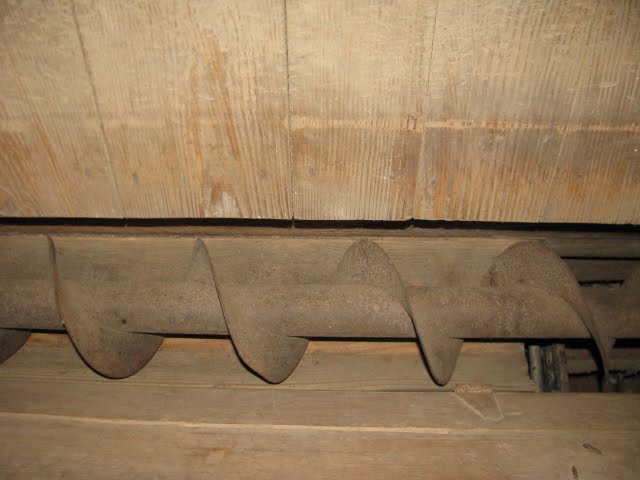
The Auger transfers seeds to a vacuum box to be blown to the seed house. A seed house is still in the process of being restored next to this building.

Brushes behind the gin saws blow the lint into the large tubular lint flue.

The Lint Flue transfers the lint to the condenser.

The Condenser traps the lint on a rotating screen drum which, as it turns, allows condensed bats of lint to slide down the lint slide to the tramper box.

The Press by means of a large upcoming hydraulic ram presses the lint into bales tied by steel bands.


The Gin Pond. You can see the Seed House that is being put in place on this end of the Gin House.

Next to the Gin is an old Country Store...filled with all sorts of interesting items.


Anybody remember when your purchases were wrapped in brown paper and a string tied tight?


Note the spittoon.

A scale....and maybe a cheese cutter?

I remember a stove like this when I was a kid. Kerosene, I think.


This is a knitting machine.

A record of store accounts from 1924.

The Delaney homestead

Out back was a barn and an old fire engine.

Door knob and keyhole

Front

In the yard a water pump and kettle.

Carol unlocking the door.

Some of the furnishings....one large main room and a kitchen.


In the middle of the kitchen was this circa 1904 "Wonder Washer." Oh, how happy she must have been not to have to wash clothes in that old wash tub any more.

The ad for the washer was framed on the wall.

The village also has its own print shop.

Some of the equipment...note the telephone on the wall.

Complete with a working linotype machine.

Printer's Prayer

The Thomas Williams Log House, circa 1830. The frame part of the house was added later. The house serves as a dressing room for weddings held in the May Chapel.

Lake Louise behind the house with a wild flower trail around it.

Muscadine grape arbor.

May Chapel, once known as Crossroads Methodist Church, 1825-1982. The chapel was named after Mrs. May Castellaw who was a resident of the original Green Frog Community. It is now used for weddings and other occasions.

The wooden pews are original to the building.

One of the early Pastors.

The organ

Redmond School, a one-room schoolhouse, circa 1920.

The inside is being restored with period school furniture.

The Bible was a common textbook.

An early teacher.

A view of the school and church and room for more buildings as the village expands.

Sunrise at Green Frog

In the morning, I was fortunate to meet the mayor of Green Frog who wanted me to invite you all to come and visit his timeless, but growing community.

Here's a link to a little video tour done for Tennessee Crossroads, if you're interested in seeing more.
Green Frog Village is located 14 miles west of Jackson, TN on Highway 412.